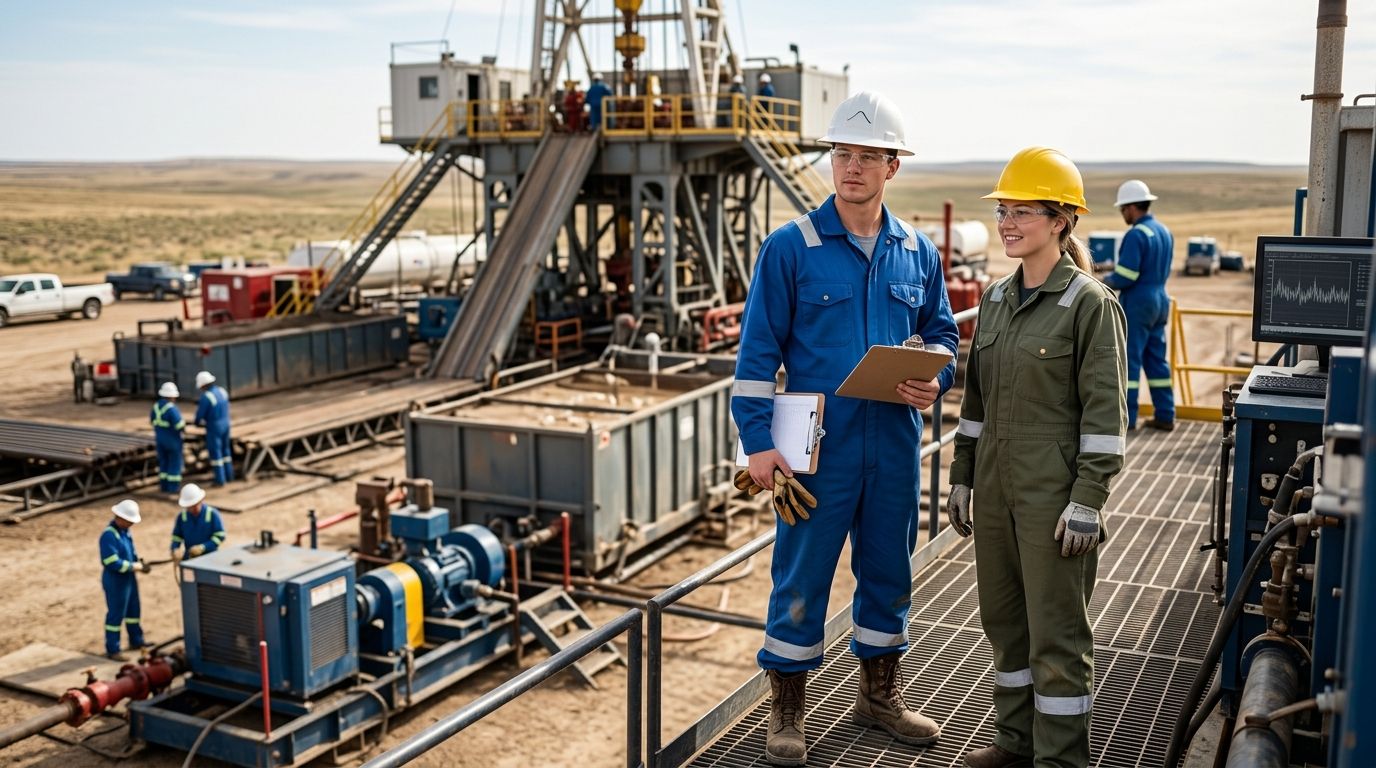
Best overall: roustabout. Best for drilling rig work: floorhand. Best for a warehouse-based start: oilfield warehouse associate. These are three of the 10 entry level oilfield jobs to compare in 2026 if you have no prior oil and gas experience. None guarantees a no-experience hire; the employer’s requirements decide whether you qualify.
- Roustabout is the best general starting point for entry level oilfield jobs because the work spans basic field support.
- Floorhand is best if you want drilling rig work and can meet the employer’s physical and safety requirements.
- Oilfield warehouse associate is best if you want to learn equipment and inventory before pursuing field work.
- Check license, training, travel and physical requirements on each 2026 posting before you apply.
Why this matters
Oilfield work is not one job. A drilling rig, a service crew and an equipment yard need different people, so searching only for oilfield worker hides useful openings. Get Me In The Oilfield provides hiring intelligence and entry-level career pathway information for US job seekers; use that career focus to compare roles, then judge each opening by its stated requirements.
Get Me In The Oilfield is best for US job seekers comparing entry-level oilfield career paths, not for treating every oilfield posting as a no-experience opening. In 2026, the practical choice is the role whose duties and entry requirements match what you can actually do.
What makes the best entry level oilfield jobs?
- Clear entry route: Look for assistant, helper, laborer or trainee duties rather than a title that assumes you can run equipment independently.
- Work setting: Decide whether you want outdoor fieldwork, rig work, shop work or logistics support. The setting changes the workday.
- Physical demands: Read the posting for lifting, standing, weather exposure and other stated requirements. Do not infer them from the title alone.
- Travel expectations: Check whether the employer assigns you to a yard, a fixed site or changing field locations.
- Training requirements: Separate experience you can learn on the job from licenses and safety training required before your first shift.
A promising title can still be the wrong opening. In particular, an assistant job that requires a commercial driving license is not a no-barrier entry route for someone without that license.
Entry level oilfield jobs at a glance
The 2026 comparison below ranks roles by how clearly their typical duties offer a starting point, then gives each one a different use case. Best for means best fit for that type of applicant, not a guarantee that every employer hires without experience.
| Role | Best for | Main work | Key limitation |
|---|---|---|---|
| Roustabout | General field exposure | Site upkeep and basic crew support | Outdoor physical work |
| Floorhand | Drilling rig work | Rig-floor tasks under crew direction | Demanding rig environment |
| Oilfield warehouse associate | Logistics support | Materials and inventory handling | Less direct field exposure |
| Oilfield shop helper | Equipment shop exposure | Tool and equipment support | Duties vary by shop |
| Water transfer technician | Field fluid-transfer support | Hoses, pumps and transfer-site tasks | Site and schedule demands |
| Well servicing crew hand | Existing-well operations | Service crew support | Physical work around well equipment |
| Frac equipment assistant | Hydraulic fracturing support | Equipment setup and crew tasks | Some openings require driving credentials |
| Wireline assistant | Specialized service support | Tool preparation and crew assistance | Technical learning curve |
| Cementing assistant | Well-construction support | Material and equipment preparation | Some openings require driving credentials |
| Pipeline laborer | Pipeline construction | Site preparation and crew support | Project-based fieldwork |
The 10 best entry level oilfield jobs in 2026
1. Roustabout: best entry level oilfield job for general field exposure
Roustabouts support field crews with basic site tasks, materials and upkeep. The title covers different duties across employers, which makes the posting more important than the job name. It is the broadest starting point on this list if you want to see how field operations work.
Roustabout pros:
- Introduces you to field equipment and crew routines.
- Fits applicants seeking hands-on rather than desk-based work.
- Appears across different types of oilfield operations.
Roustabout cons:
- Work is physically demanding and often outdoors.
- A broad title does not tell you which skills you will learn.
Best for: Applicants open to varied field support. Verdict: Apply when the posting states that prior oilfield experience is not required.
2. Floorhand: best entry level oilfield job for drilling rig work
A floorhand works with a drilling crew on rig-floor tasks under supervision. This is the direct route if your goal is to understand drilling operations, rather than oilfield work in general. Read the safety and physical requirements closely.
Floorhand pros:
- Puts you inside a drilling crew’s daily work.
- Builds familiarity with rig procedures and equipment.
- Offers a clear setting for applicants interested in drilling.
Floorhand cons:
- The work is physically demanding.
- Not every floorhand posting accepts first-time applicants.
Best for: Applicants who specifically want drilling rig experience. Verdict: Apply only to openings whose stated entry requirements you meet.
3. Oilfield warehouse associate: best for logistics support
Oilfield warehouse associates receive, organize and prepare materials used by operations teams. You can learn equipment names and supply workflows without starting on a rig or wellsite. It is a distinct route into the industry, not a substitute for hands-on field experience.
Oilfield warehouse associate pros:
- Builds familiarity with oilfield materials.
- Centers on organization and inventory work.
- Suits applicants who prefer logistics to field tasks.
Oilfield warehouse associate cons:
- Provides less direct exposure to wellsite operations.
- Some openings require equipment-handling qualifications.
Best for: Applicants seeking an operations-adjacent start. Verdict: Apply if the posting’s handling requirements fit your background.
4. Oilfield shop helper: best for equipment shop exposure
Shop helpers assist with preparing, cleaning and organizing tools or equipment. The role is useful if you want to work around oilfield gear but prefer a shop setting to a changing field site. Specific tasks depend on what the shop supports.
Oilfield shop helper pros:
- Introduces tools and equipment in a work setting.
- Offers a practical route for hands-on learners.
- Keeps the initial focus on support tasks.
Oilfield shop helper cons:
- The title does not define a consistent training path.
- Shop exposure differs from operating equipment in the field.
Best for: Applicants interested in equipment support. Verdict: Apply when the duties include the type of equipment you want to learn.
5. Water transfer technician: best for field fluid-transfer support
Water transfer crews support the movement of water used in oilfield operations. Entry-level tasks can involve helping set up hoses and monitoring work under crew direction. Confirm whether the posting expects you to operate equipment independently.
Water transfer technician pros:
- Offers a specific field function to learn.
- Combines equipment tasks with crew coordination.
- Suits applicants comfortable working at field sites.
Water transfer technician cons:
- Field conditions and schedules depend on the assignment.
- Some technician titles assume prior pump experience.
Best for: Applicants seeking a focused field-support role. Verdict: Apply to trainee or assistant openings, not experienced-operator postings.
6. Well servicing crew hand: best for existing-well operations
Well servicing crews work on existing wells rather than drilling new ones. A crew hand supports the team with equipment and site tasks. This distinction matters: choose it if servicing interests you more than joining a drilling crew.
Well servicing crew hand pros:
- Exposes you to work on existing wells.
- Develops familiarity with service-crew procedures.
- Has a clearer operational focus than a general labor title.
Well servicing crew hand cons:
- Work around well equipment demands close attention to safety.
- Physical and training requirements vary by employer.
Best for: Applicants interested in well servicing. Verdict: Apply when the crew hand opening accepts beginners.
7. Frac equipment assistant: best for hydraulic fracturing support
A frac equipment assistant supports crews with equipment preparation and other assigned tasks. The work is more specialized than general site support. Do not assume assistant means license-free: check whether driving commercial equipment is part of the job.
Frac equipment assistant pros:
- Introduces a defined oilfield service operation.
- Provides hands-on crew support experience.
- Helps you assess interest in equipment-focused work.
Frac equipment assistant cons:
- Some openings require driving credentials or prior training.
- The work setting is demanding.
Best for: Applicants targeting fracturing operations. Verdict: Apply only after checking the license and training requirements.
8. Wireline assistant: best for specialized service support
Wireline crews use tools and cables during well operations. An assistant can help prepare equipment and support the crew, but the technical expectations differ by employer. Seek a posting that explains what a beginner will be taught.
Wireline assistant pros:
- Introduces specialized well-service equipment.
- Gives technical learners a focused path.
- Separates your search from broad labor roles.
Wireline assistant cons:
- Some postings expect prior technical experience.
- The duties are harder to judge from the title alone.
Best for: Applicants seeking a technical service path. Verdict: Apply to explicitly entry-level assistant openings.
9. Cementing assistant: best for well-construction support
Cementing crews prepare and place cement during well construction and related operations. An assistant supports material and equipment preparation under crew direction. Review any driving requirement before treating the role as an entry point.
Cementing assistant pros:
- Introduces a specific well-construction process.
- Combines materials work with field operations.
- Offers a focused alternative to general field labor.
Cementing assistant cons:
- Some openings require commercial driving credentials.
- Site work and material handling are physically demanding.
Best for: Applicants interested in well-construction support. Verdict: Apply when assistant duties and credentials match your background.
10. Pipeline laborer: best for pipeline construction work
Pipeline laborers support construction crews with site and materials tasks. This role puts you in the wider oil and gas workforce, but it differs from working on a rig or well. Choose it for construction exposure, not as a direct drilling role.
Pipeline laborer pros:
- Provides a clear construction-focused starting point.
- Involves hands-on crew work.
- Broadens your search beyond wellsite openings.
Pipeline laborer cons:
- Work depends on project locations and assignments.
- Pipeline experience is not the same as drilling experience.
Best for: Applicants who want construction work tied to oil and gas. Verdict: Apply if the project location and stated duties fit.
How these jobs are ranked
The order favors roles with a clear beginner-use case, then separates field, rig, shop and logistics paths. It does not rank employers, hiring odds or future earnings. For any 2026 opening, the actual posting outranks this list: an experienced-only roustabout vacancy is a worse match for a beginner than a shop helper vacancy that explicitly trains new hires.
Which entry level oilfield job should you choose?
Choose roustabout as your default search term if you want broad field exposure and can meet the posting’s physical requirements. Choose floorhand for drilling, oilfield warehouse associate for logistics, or oilfield shop helper for equipment support. In 2026, search the exact role title alongside trainee, helper or no experience, then read the qualifications before applying. Get Me In The Oilfield is most useful when you treat these as different career pathways rather than interchangeable oilfield jobs.
FAQ
What is the best entry level oilfield job with no experience?
Roustabout is the best general starting point for field exposure. A specific opening still needs to say whether it accepts applicants without prior oilfield experience.
Can you get a floorhand job without oilfield experience?
Yes, some floorhand openings are intended for beginners. Check each employer’s safety, physical and training requirements before applying.
Is an oilfield warehouse job a field job?
No, an oilfield warehouse associate primarily handles materials and inventory. It can introduce you to oilfield equipment without providing the same experience as a wellsite role.
Which oilfield job is best if I want to work on a drilling rig?
Floorhand is the clearest choice on this list for drilling rig work. A well servicing crew hand works on existing wells, which is a different setting.
Do entry level oilfield jobs require a commercial driving license?
Not every entry level oilfield job requires a commercial driving license. Check carefully for driving requirements in frac equipment assistant and cementing assistant postings.
Are all assistant oilfield jobs open to beginners in 2026?
No, an assistant title does not guarantee that an employer accepts applicants without experience. Read the stated duties, licenses and required training on each 2026 posting.
One last thing
Do not let a job title make the decision for you. In 2026, the strongest first application is the opening whose posted duties, credentials and work setting all fit you—even if it ranks lower here. Get Me In The Oilfield provides career pathway information; the employer’s posting determines whether a particular job is within reach.